The True Cost of Each Option: It's Never Just the Carpet Rate
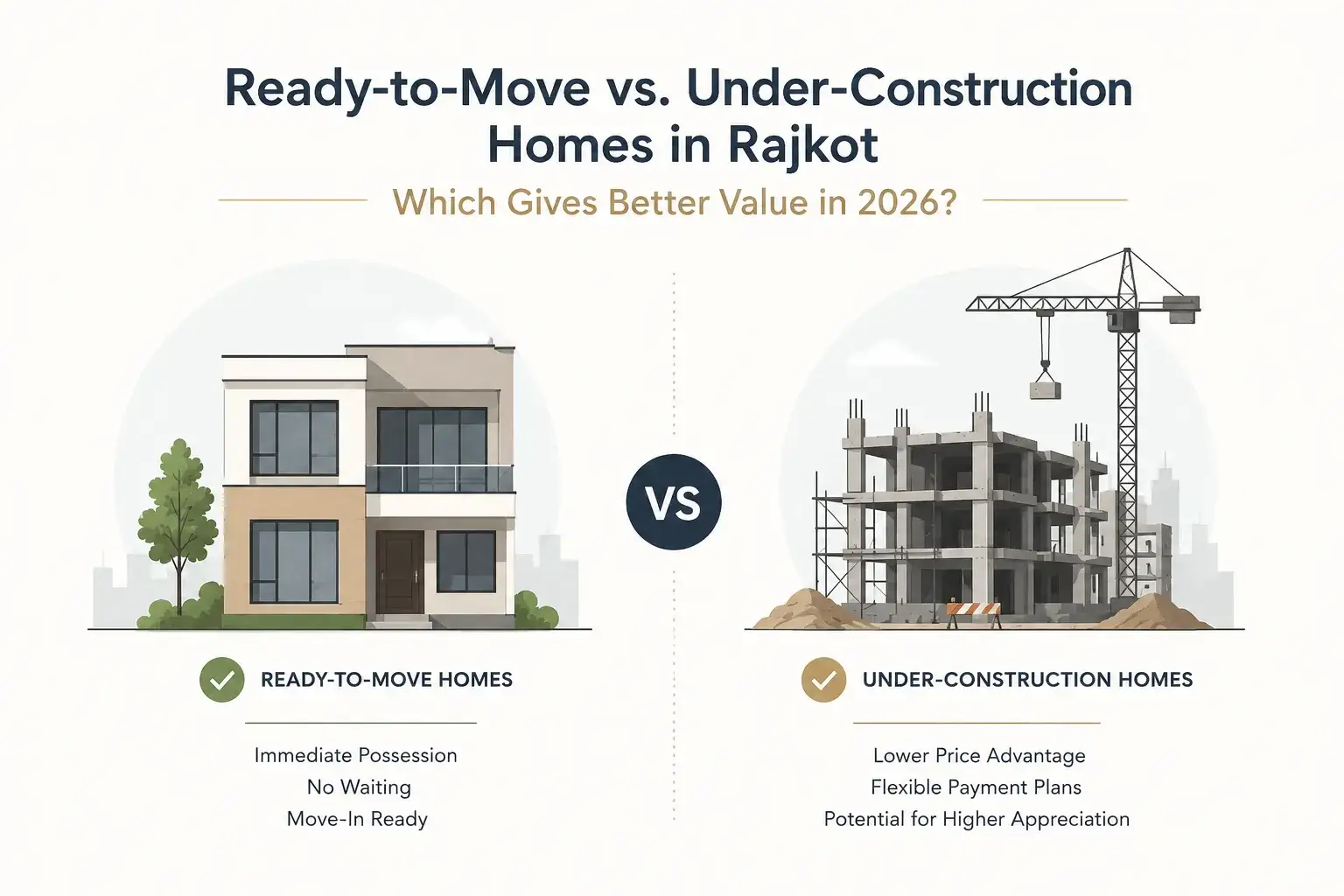
Let's take a realistic scenario. You're eyeing a 3 BHK in a decent mid-segment project — one on the 150-Foot Ring Road corridor, and another on the Kalavad Road extension. Here's what the outflow really looks like when you compare a ready-to-move unit at ₹4,800/sq. ft. against an under-construction one at ₹4,200/sq. ft.
| Cost Head | Ready-to-Move (1,500 sq. ft.) | Under-Construction (1,500 sq. ft.) |
|---|---|---|
| Base Price | ₹72,00,000 | ₹63,00,000 |
| GST | Nil (completed property, no GST) | 5% (no ITC for residential) = ₹3,15,000 |
| Registration & Stamp Duty | ~₹4,30,000 (6% on total) | Paid later, but on circle rate or agreement value — roughly similar at possession |
| Pre-EMI Interest (2-year construction) | Not applicable | Assuming 80% loan, ~₹8.5 lakh outflow with no tax benefit until possession |
| Interior & Furnishing | Often semi-furnished; immediate move-in, saves 8–12 months of rental | You pay roughly ₹6–8 lakh extra later, plus GST on materials |
| Opportunity Cost (Rent) | You shift in now. No parallel rent. | You continue paying ₹15,000–20,000/month rent for 2 years = ₹3.6–4.8 lakh |
| Total Cash Outflow Until You Occupy | ~₹76.3 lakh (includes stamp, no rent loss) | ~₹79.5 lakh (includes GST, pre-EMI, rent paid while waiting) |
The price gap between the two options often shrinks dramatically once you account for these real-world drains. And that's before we even talk about inflation in raw material costs that the builder might pass on if you haven't locked in a fixed-price agreement.
Financing: How Your Home Loan Behaves Differently
This is where I've seen even smart buyers trip. A bank's loan approval isn't the same for both types of property.
With a ready-to-move home, your full loan gets disbursed at once, EMI starts immediately, and you're eligible for tax benefits on both interest (Section 24) and principal (Section 80C) from the same financial year. The house is also available as collateral for other credit needs right away.
Under-construction properties come with a pre-EMI trap. The bank disburses funds in stages linked to construction milestones. You pay only interest on the disbursed amount until possession — known as pre-EMI. That amount feels small initially (maybe ₹18,000/month), but it adds zero to your principal repayment. Worse, you get no income tax deduction on pre-EMI until the project completes. Once you get possession, you can claim the aggregate pre-EMI interest in five equal instalments, but by then you've already suffered a cash flow drag of nearly 2–3 years.
Some Rajkot buyers mistakenly think under-construction means "cheaper loan." It's not. The interest rate is the same, but your equity build-up is delayed and your tax savings get postponed exactly when your liquidity is tight.
Risk Analysis: The Factor Most Brochures Gloss Over
Rajkot's real estate sector isn't Bengaluru or Noida where towering skeletons of stalled projects dot the skyline, but risk hasn't vanished. Even with RERA, a project can slide from a 24-month timeline to 36 months without the buyer seeing any real compensation until long after.
With a ready-to-move unit, you see exactly what you're paying for. The natural light in the living room at 4 p.m., the quality of bathroom fittings, the actual society maintenance standards — everything is testable. No promises, no photoshop.
With under-construction, your contract is essentially a brand promise. You're betting on the builder's execution capability. In Rajkot, delays of 9–12 months are common even among known developers because of monsoon disruption, labour movements during festivals, or delayed environmental clearances. RERA registration helps — you can track the quarterly progress report on the Gujarat RERA portal — but it doesn't auto-credit a penalty into your bank account. You still have to chase, escalate, or wait.
Ask the builder one question: "Give me the list of the last three projects you delivered, with start and possession dates." If they hesitate, walk away. Also, check the project's RERA registration number on gujrera.gujarat.gov.in and look at the quarterly progress status and any complaint history. This is non-negotiable.
Returns and Appreciation: Which Grows Your Wealth Faster?
Here's the part that stirs maximum debate in our Rajkot office. Under-construction properties often appear to give higher absolute returns because you enter at a lower base. A project near the newly widened 150-Foot Ring Road that launches at ₹3,900/sq. ft. could easily touch ₹5,200/sq. ft. by possession in 2028 — a theoretical appreciation of 33% over three years.
However, ready-to-move homes in Rajkot are not static assets. A well-maintained, gated society on Kalavad Road or near Nana Mava Circle has been clocking steady 5–7% annual appreciation, with the added advantage that you can generate rental income from day one (₹15,000–25,000/month for a 3 BHK in decent locations). That rental yield acts as a hedge, bringing your net holding cost close to zero after tax benefits.
Consider the net equity position after five years. If you buy under-construction today and take possession in 2028, you start building full equity only from 2028 onward. The ready-to-move buyer who starts in 2026 has already repaid two years of principal by then. In pure balance-sheet terms, the head start often beats the launch discount, especially in Rajkot's mature corridors where land prices aren't doubling overnight anymore.
The Rajkot Factor: Local Dynamics That Change the Math in 2026
Rajkot is at an inflection point. The expanded airport terminal, the Atal Sarovar project, and the AIIMS campus on the outskirts are creating new demand pockets. This means under-construction projects in areas like Metoda, Gondal Road extension, and the upcoming southern stretch of the Ring Road could genuinely deliver sharp appreciation as connectivity improves over the next 4–5 years.
But in saturated, high-demand zones like Kalavad Road, Yagnik Road, and Amin Marg, a ready-to-move flat is a scarcity product. Land parcels are extremely limited, and no new high-rises can come up without redevelopment. In these pockets, the premium you pay today for immediate possession is almost always justified because supply is capped while demand from doctors, businessmen, and NRIs remains robust.
What I tell my own clients: if you're betting on a "future corridor," an under-construction investment makes sense but only if the developer owns the land outright and has all sanctions in place — ask for the NA order and approved building plan copies upfront. If you're buying a primary residence to live in for the next 8–10 years in a tried-and-tested neighbourhood, ready-to-move spares you the agony of uncertainty.
Who Should Pick What? Real-World Guidance
Ready-to-move is right for you if:
- You're currently paying high rent and want to stop the monthly drain immediately.
- You have a specific possession deadline — children's school admission, ageing parents moving in, marriage timeline.
- You're risk-averse and want to see the exact flat, the exact view, and the community you're joining before committing.
- You're an NRI looking for a lock-and-leave property that can be managed by a family member or facility team from day one.
Under-construction can work if:
- You have a comfortable existing living arrangement and can wait 2–3 years without stressing the family.
- You've verified the builder's delivery record, RERA compliance, and bank loan sanction for the project (if leading banks have approved the project, that's a green flag).
- Your goal is purely capital appreciation and you're targeting an upcoming infrastructure zone where today's rates won't hold for long.
- You have the cash flow to manage pre-EMI plus current rent without lifestyle compromise.